Theogony
Theogony

Greek
Theogony
Name in Non-English, or Alternative Name/s
The Theogony of Hesiod; Hesiod's Theogony; Hesiod: Theogony
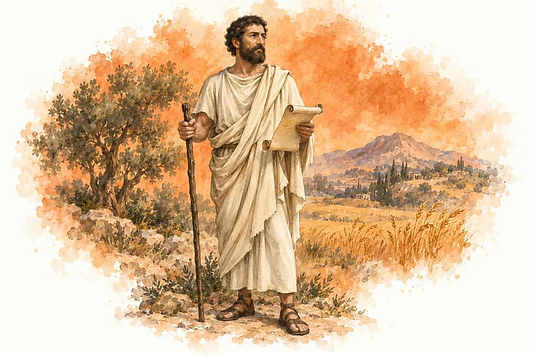
Mythopouch artistic interpretations
English Edition Translation used on this Page
Hugh G. Evelyn-White · 1914 · Not specified in the standalone PDF (new typesetting, 2026).
Time Period
Ancient Greece. English translation first published in 1914; standalone English reading PDF typeset in 2026.
Introduction - Overview
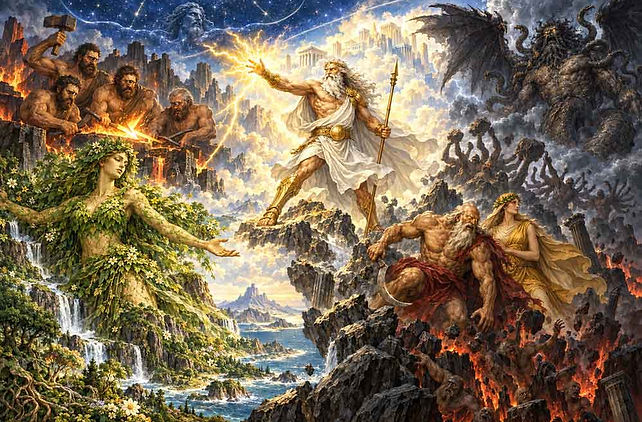
Theogony is Hesiod's ancient Greek poem about the origins of the world and the families of the gods. Beginning with the Muses and the first divine powers, it follows the births of gods and monsters, the conflict between successive generations, and the establishment of Zeus's rule.
The reading copy is a standalone PDF of Hugh G. Evelyn-White's English translation, first published in 1914. This 34-page PDF was newly typeset in 2026. It contains Theogony only, not the full collected volume, and is not a facsimile of a historical printing.
The ancient poem and this historical English translation are separate from Mythopouch's modern educational retelling.
The Work...
Theogony
The poem opens with the Muses of Helicon and the gift of song to Hesiod. It then turns to the beginning of things: Chaos, Earth, Tartarus and Eros, followed by the divine families through which the natural world takes shape. Genealogy is central to the work. Earth and Heaven, Night, Sea, Oceanus and the Titans each introduce further generations of beings.
The conflict between Heaven and his children leads to Cronos's attack and the birth of Aphrodite. Later, Rhea conceals Zeus while Cronos swallows their other children. Zeus's rise, his allies, the punishment of Prometheus, the war against the Titans and the defeat of Typhoeus frame the succession to divine rule. The poem also gives extended attention to Hecate, the oath of Styx, the depths of Tartarus, and the offspring of gods and mortals.
The source PDF is titled Theogony, by Hesiod, translated into English by Hugh G. Evelyn-White. Its cover identifies 1914 as the translation's first publication year and 2026 as the date of the PDF formatting. It is a newly typeset English reading copy rather than a scan of a printed edition.
The PDF has 34 pages, including its introductory title page. The translation begins on PDF page 2 and ends on page 34. It runs from lines 1-1022 and retains the alternative passage labelled 929a-929t. The Greek text, editorial endnotes, other works and later appendices are not included.
Use the poem's line-range labels when checking an episode, rather than the chapter numbers of the modern retelling. The PDF's page numbers and paragraph layout are new, so page references from an older printed edition do not identify the same pages in this file. The alternative passage is explicitly labelled and should remain distinguishable from the surrounding sequence.
The retelling adds narrative development, interpretation and contextual material. Its chapter on the first woman explicitly combines the Theogony account with Pandora material from Works and Days. These are separate ancient poems, and Works and Days is not included in this standalone source PDF. For source checking, keep that distinction rather than attributing the entire combined story to Theogony.
Summary
Hesiod's Theogony traces the first gods, divine families and the rise of Zeus. The source is Hugh G. Evelyn-White's 1914 English translation in a standalone 34-page PDF newly typeset in 2026.
Source Note
Hesiod's ancient poem and Hugh G. Evelyn-White's original 1914 English translation are public domain in Australia and the United States. The source PDF is a newly typeset English reading copy; it excludes other works and later appendices. No new copyright claim is made over the historical text. Mythopouch's modern retelling, commentary and original imagery are separate modern work.