Herodotus: The Histories
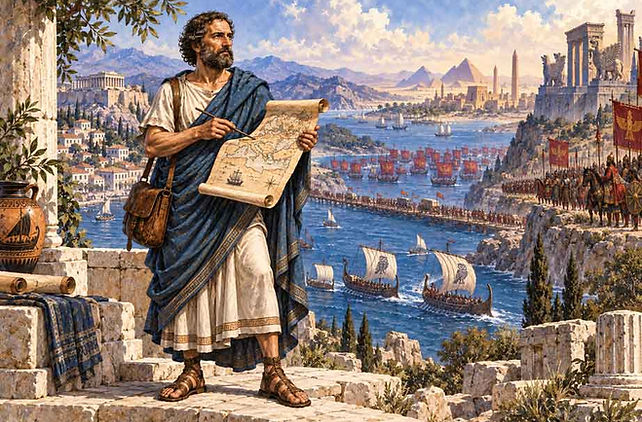
Herodotus: The Histories

Greek
Herodotus: The Histories
Name in Non-English, or Alternative Name/s
The Histories; The Histories of Herodotus; Historiae; Herodotus
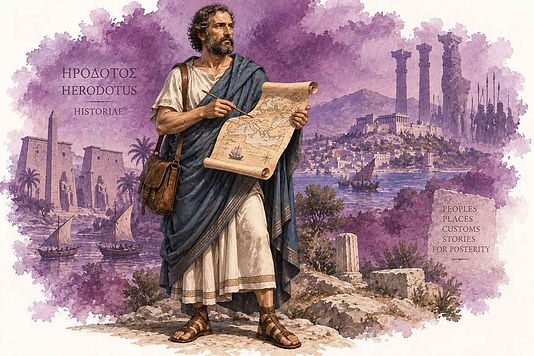
Mythopouch artistic interpretations
English Edition Translation used on this Page
Henry Cary · 1904 · D. Appleton and Company
Time Period
Composed during the mid-to-late 5th century BCE. English reading witness: Henry Cary translation, D. Appleton and Company, 1904.
Introduction - Overview
Herodotus' Histories is one of the foundational surviving works of Greek historical writing. Written in the 5th century BCE, it investigates peoples, rulers, customs, conflicts and stories leading into the wars between the Greek states and the Persian Empire.
The work is traditionally divided into nine books. It begins with Lydia, Croesus and the rise of Persian power under Cyrus, moves through Egypt, Cambyses, Darius, Scythia and the Ionian Revolt, and culminates in the Persian invasions of Greece under Darius and Xerxes. Herodotus also records geography, ethnography, religious traditions, oral reports, political stories and extraordinary claims.
Mythopouch uses the complete 1904 D. Appleton edition translated by Henry Cary as its public-domain English reading witness. The edition contains all nine books and includes a critical and biographical introduction by Basil L. Gildersleeve.
The Work...
Herodotus: The Histories
Herodotus presents his work as an inquiry intended to preserve the deeds of Greeks and non-Greeks and investigate the causes of their conflict. That purpose gives the Histories a wider scope than a continuous account of battles. Herodotus repeatedly turns aside to describe places, peoples, customs, rulers, wonders and competing accounts.
Book I follows Croesus of Lydia and the growth of Persian power under Cyrus. Book II turns largely to Egypt. Book III continues with Cambyses, the succession crisis after his death and the rise of Darius. Book IV ranges through the Persian expedition against the Scythians and material concerning Libya and Cyrene. Books V and VI bring the narrative through the Ionian Revolt and the first Persian invasion of mainland Greece, including Marathon.
Books VII to IX form the closing movement of the work. They recount Xerxes' invasion of Greece, the mobilisation of Persian forces, Thermopylae, the naval campaign and Salamis, followed by Plataea, Mycale and the closing operations at Sestos. The traditional nine-book division and the later association of the books with the nine Muses were not titles supplied by Herodotus himself.
Herodotus is important to Mythopouch because many people, places and traditions in his work sit at the boundary between history, legend, religion and inherited storytelling. He preserves competing versions and sometimes distinguishes what he saw, what he heard and what he doubted. His testimony is therefore used as an ancient source witness rather than treated as automatically infallible.
The source witness used by Mythopouch is The Histories of Herodotus, translated by Henry Cary and published by D. Appleton and Company in 1904. It contains all nine books in one volume. The Cary translation uses older English and reflects the scholarship of its period, but it provides a complete public-domain English text suitable for source checking.


Summary
Herodotus' Histories investigates the rise of Persian power and the conflicts between Persia and the Greek states while preserving extensive material on rulers, peoples, customs, geography and tradition. Mythopouch uses Henry Cary's complete 1904 translation as its public-domain English source witness.
Source Note
Herodotus' ancient Greek work is public domain. Henry Cary died in 1870, and the 1904 D. Appleton edition used as the English source witness is public domain. The Mythopouch retelling is original educational wording and is not Cary's translation. Mythopouch commentary and original imagery are © Mythopouch.