Pyramid Texts
Pyramid Texts

Egyptian
Pyramid Texts
Name in Non-English, or Alternative Name/s
Pyramid Texts; Old Kingdom Pyramid Texts; Saqqara Pyramid Texts
Mythopouch artistic interpretations
English Edition Translation used on this Page
E. A. Wallis Budge · 1914 · J. M. Dent & Sons Ltd.
Time Period
Old Kingdom, late Fifth to Eighth Dynasties, approximately 2350-2150 BCE. Historical English source witness: E. A. Wallis Budge, 1914.
Introduction - Overview
The Pyramid Texts are an ancient Egyptian corpus of royal funerary utterances first inscribed inside pyramids at Saqqara in the late Old Kingdom. They combine offering formulae, protective spells, hymns, ritual instructions, divine identifications and texts for the dead ruler's resurrection and ascent.
The downloadable historical English witness for this Sources page is Chapter II, 'The Pyramid Texts', from E. A. Wallis Budge's The Literature of the Ancient Egyptians (1914). Budge's chapter is a public-domain historical selection, not a complete modern edition of every known Pyramid Text.
The Work...
Pyramid Texts
The Pyramid Texts do not form one ancient book with a single author or fixed table of contents. Different pyramids preserve different selections and arrangements. The earliest surviving royal corpus is in the pyramid of Unas, followed by texts for Teti, Pepi I, Merenre and Pepi II. By the end of the Sixth Dynasty, royal women also received Pyramid Texts, and later discoveries have continued to enlarge the known corpus.
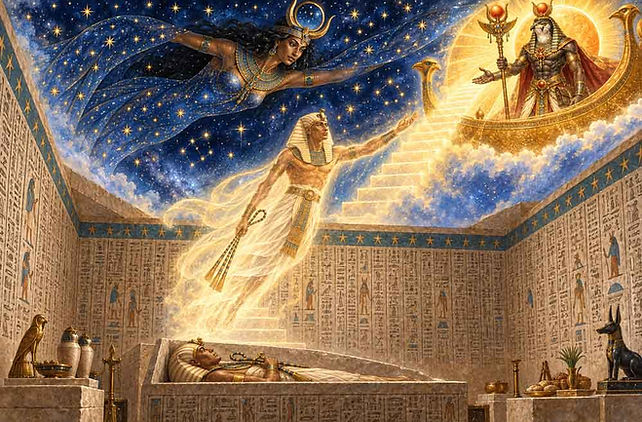
Their central purpose is funerary. The dead ruler is restored, purified and fed; protected from serpents and hostile beings; identified with gods such as Osiris and Horus; ferried or lifted through the celestial landscape; and established among the gods and stars. Some utterances belong to offering and mouth-opening rituals, while others use commands, threats, hymns and magical identifications.
Modern numbering can be confusing. Kurt Sethe's early twentieth-century edition established the familiar sequence of 714 numbered utterances, but later discoveries added further texts and variants. Counts also differ according to which pyramid, edition and numbering system is being discussed. Mythopouch therefore avoids treating one later total as a final count for the entire corpus.
The public source supplied here is Budge's 1914 Chapter II. It contains a historical introduction and English selections under headings including the Opening of the Mouth, funerary offerings, hymns to the sky and sun gods, the king in heaven, and the hunting and slaughter of the gods. It is useful as an accessible period witness but does not contain the full corpus known to Egyptology today.
For the Mythopouch retelling, the ancient material was also checked against Samuel A. B. Mercer's 1952 translation and commentary as a private research reference. Mercer's file is not supplied, hosted or reproduced by Mythopouch. Modern archaeological and Egyptological sources were used to check discovery history and later additions to the corpus.

Summary
The Pyramid Texts are ancient Egyptian royal funerary utterances for resurrection, protection and ascent. This page supplies Budge's 1914 public-domain historical English selection while identifying its limits as a selection rather than the complete modern corpus.
Source Note
The ancient Egyptian Pyramid Texts are public-domain source material. The downloadable witness for this page is E. A. Wallis Budge, The Literature of the Ancient Egyptians, published in 1914. Budge died in 1934. Under Australian copyright-duration guidance, published text is out of copyright where it was published before 1955 and the creator died before 1955. Mythopouch should upload only the verified 1914 Budge source file identified in the accompanying README. Samuel A. B. Mercer's 1952 translation is used only as a private research reference and is not distributed by Mythopouch.