Hatshepsut Divine Birth Inscriptions
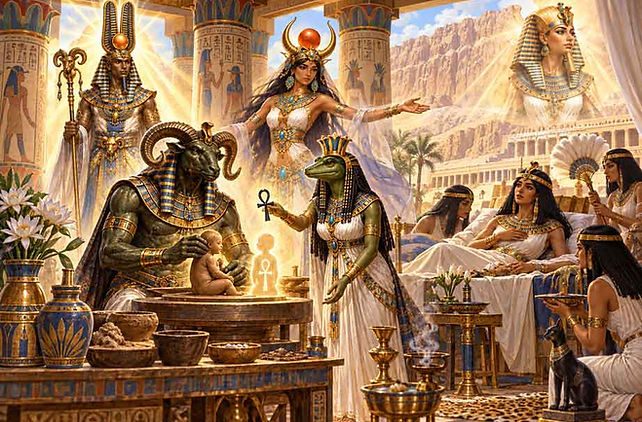
Hatshepsut Divine Birth Inscriptions

Egyptian
Hatshepsut Divine Birth Inscriptions
Name in Non-English, or Alternative Name/s
Hatshepsut's Divine Birth; Divine Birth of Hatshepsut; The Birth of Queen Hatshepsut; Deir el-Bahari Divine Birth Inscriptions
Mythopouch artistic interpretations
English Edition Translation used on this Page
James Henry Breasted · 1906 · University of Chicago Press
Time Period
Eighteenth Dynasty, reign of Hatshepsut, c. 1479-1458 BCE. Public-domain English source witness: James Henry Breasted, 1906.
Introduction - Overview
The divine-birth inscriptions of Hatshepsut at Deir el-Bahari form a sequence of reliefs and hieroglyphic texts presenting her conception and birth as part of a divine plan. Amun chooses Queen Ahmose, appears in the form of King Thutmose I, fathers Hatshepsut and announces her future kingship. Khnum then fashions Hatshepsut and her ka, while gods and goddesses attend her birth, presentation and nursing.
The original work was created by anonymous ancient Egyptian royal scribes and temple artists during Hatshepsut's reign. Mythopouch uses James Henry Breasted's 1906 public-domain English translation and commentary as the source witness, drawing on the Deir el-Bahari documentation published by Édouard Naville.
The source extract used here covers Breasted's section 'The Birth of Queen Hatshepsut', §§187-212, and ends before the separate coronation sequence.
The Work...
Hatshepsut Divine Birth Inscriptions
The Deir el-Bahari birth cycle begins with Amun among the gods. He announces the future authority of the child and then consults Thoth, who identifies Queen Ahmose, wife of Thutmose I, as the woman who will bear her.
Amun comes to Ahmose in the appearance of Thutmose I. The inscription describes the divine conception and records Amun naming the child Khnemet-Amun-Hatshepsut and declaring that she will exercise kingship over the land.
Amun then commands Khnum to fashion Hatshepsut and her ka. Khnum forms them on his potter's wheel while Heket extends the sign of life. The accompanying words grant Hatshepsut life, health, lands, peoples, offerings and a future upon the throne of Horus.
The sequence moves to childbirth. Khnum and Heket lead Queen Ahmose towards the birth chamber, where divine attendants surround the mother and child. Hathor later presents Hatshepsut to Amun, who receives her as his daughter and future ruler. Hatshepsut and her ka are then nursed by divine Hathors.
These scenes do not claim that Hatshepsut lacked royal ancestry. She was already the daughter of Thutmose I and Queen Ahmose. Instead, the programme places her kingship within divine order by making Amun her divine father and portraying her future rule as intended before birth.
The reliefs also preserve the way Egyptian royal art could adapt established conventions. Breasted noted that some figures of the unborn Hatshepsut follow conventional male royal-child models even though the surrounding grammar identifies her as female.
The source witness used by Mythopouch is James Henry Breasted's 1906 English publication in Ancient Records of Egypt, Volume II. Breasted relied on Édouard Naville's published records of Deir el-Bahari and compared damaged passages with parallel divine-birth scenes where necessary. The extract used here stops with the birth cycle and does not include Hatshepsut's later coronation narrative.


Summary
Hatshepsut's divine-birth inscriptions at Deir el-Bahari present Amun as her divine father and her future kingship as ordained before birth. Mythopouch uses James Henry Breasted's 1906 public-domain English translation and commentary as its source witness.
Source Note
The ancient Egyptian inscriptions and reliefs are public domain. James Henry Breasted's 1906 English translation and commentary are also public domain. The clean source extract contains only public-domain material. Mythopouch commentary, retelling and original imagery are © Mythopouch.