Book of Overthrowing Apep
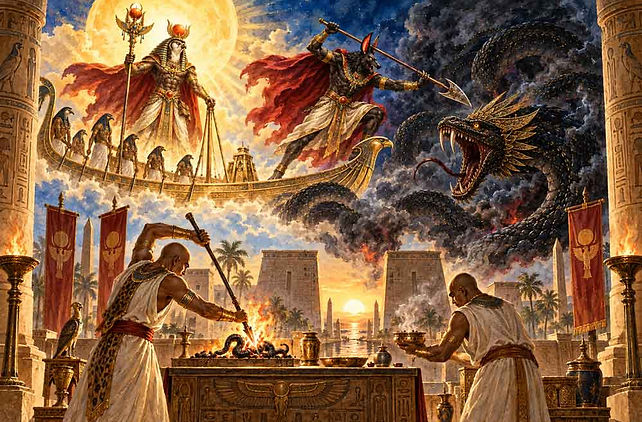
Book of Overthrowing Apep

Egyptian
Book of Overthrowing Apep
Name in Non-English, or Alternative Name/s
Book of Overthrowing Apophis; Apep Ritual; Apophis Ritual; Bremner-Rhind Papyrus Apep Ritual
Mythopouch artistic interpretations
English Edition Translation used on this Page
E. A. Wallis Budge · 1910 · British Museum
Time Period
Ptolemaic Period, 305 BCE according to the manuscript colophon. Historical English witness: E. A. Wallis Budge, 1910.
Introduction - Overview
The Book of Overthrowing Apep is an ancient Egyptian ritual text preserved in the Bremner-Rhind Papyrus, British Museum EA 10188. The manuscript is Ptolemaic and is dated to 305 BCE according to its colophon. Its Apep material occupies columns 22-32, followed by the Names of Apep in columns 32-33.
The downloadable source file on this page is a newly typeset Mythopouch historical source reader prepared from public-domain material by E. A. Wallis Budge. Budge's 1910 Facsimiles of Egyptian Hieratic Papyri in the British Museum is the controlling bibliographic witness. The file is not a modern copyrighted translation and does not redistribute a third-party library scan.
The Work...
Book of Overthrowing Apep
The Book of Overthrowing Apep is a ritual complex aimed at defeating Apep, the serpent who obstructs Ra and threatens the ordered passage of the sun. The surviving text combines spoken formulas with prescribed physical acts. Budge's descriptions identify ritual actions including spitting on Apep, trampling him with the left foot, piercing him with a lance, binding him, cutting him with a knife and destroying his image by fire.
The ritual works through repetition. Apep is attacked not only as a physical enemy but through his name, soul, shade and associated hostile powers. Wax figures and written images are treated as ritual embodiments of the enemy. The text prescribes burning and repeated recitation at significant times so that the hostile force is continually subdued.
The Bremner-Rhind Papyrus also preserves two important creation accounts within the Apep material. The creator speaks of coming into being before the differentiated world, creating through divine power and bringing forth Shu and Tefnut. In the ritual setting, creation itself becomes part of the argument against chaos: the ordered cosmos established by the creator is renewed as Apep is defeated.
The manuscript held by the British Museum is EA 10188. The museum identifies the Book of Overthrowing Apep in columns 22-32 and dates the papyrus to 305 BCE according to the colophon. E. A. Wallis Budge published the material in earlier and later public-domain works and in 1910 issued the British Museum volume Facsimiles of Egyptian Hieratic Papyri in the British Museum, with Descriptions, Translations, etc.
The downloadable Mythopouch source file is a historical source reader rather than a reproduction of a modern edition. It brings together the source identity, ritual structure, prescribed actions, creation material and historical publication context needed to read the separate Mythopouch retelling alongside the public-domain Budge witness.


Summary
An ancient Egyptian ritual against Apep, preserved in the Bremner-Rhind Papyrus. This page supplies a newly typeset public-domain historical source reader based on E. A. Wallis Budge's 1910 British Museum witness.
Source Note
The ancient Egyptian text is public-domain source material. The historical material used for the downloadable source reader is by E. A. Wallis Budge, whose relevant editions were published between 1890 and 1912 and who died in 1934. The 1910 British Museum edition is the controlling bibliographic witness. The Mythopouch file is newly typeset and does not reproduce a modern copyrighted translation or redistribute a third-party library scan. Modern translations, including later scholarly editions, are not supplied or reproduced.