Culhwch and Olwen
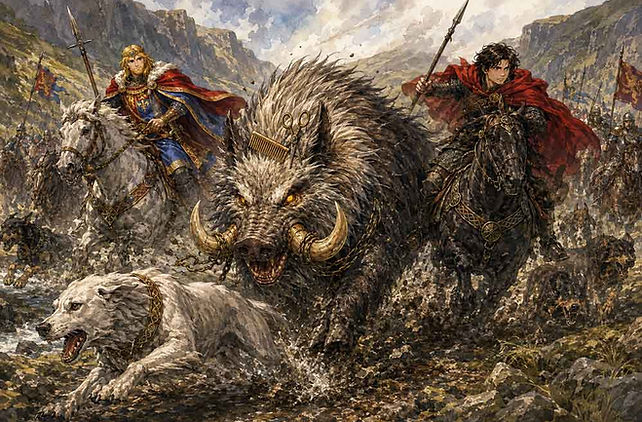
Culhwch and Olwen

Arthurian
Culhwch and Olwen
Name in Non-English, or Alternative Name/s
Culhwch ac Olwen; Kilhwch and Olwen; Kilhwch and Olwen or The Twrch Trwyth
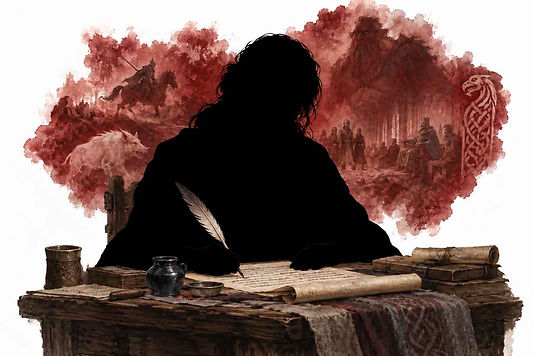
Mythopouch artistic interpretations
English Edition Translation used on this Page
Lady Charlotte Guest · 1842 · Longman, Orme, Brown, Green, and Longmans / W. Rees
Time Period
Medieval Welsh tale, probably composed around c. 1100, though scholarly dating ranges from the late 10th to the 12th century. Survives in the White Book of Rhydderch and Red Book of Hergest. English witness: Lady Charlotte Guest, 1842.
Introduction - Overview
Culhwch and Olwen is an anonymous medieval Welsh Arthurian tale and one of the earliest surviving prose narratives to place Arthur and his war-band at the centre of an adventure. Culhwch is bound by his stepmother's destiny to marry only Olwen, daughter of the giant Ysbaddaden Pencawr. Because Ysbaddaden is fated to die when his daughter marries, he demands a long series of seemingly impossible tasks before he will surrender her.
The tale survives in medieval Welsh manuscripts, including an incomplete version in the White Book of Rhydderch and a complete version in the Red Book of Hergest. Its exact date of composition remains debated, but it is widely treated as the oldest surviving native Welsh Arthurian prose tale.
The source witness used by Mythopouch is Lady Charlotte Guest's 1842 publication, Part IV of The Mabinogion, containing Kilhwch and Olwen. Guest translated and edited the medieval Welsh material into English and supplied explanatory notes. Mythopouch treats the anonymous Welsh tale as the original work and Guest as the translator and editor of this public-domain reading witness.
The Work...
Culhwch and Olwen
Culhwch and Olwen preserves an Arthurian world very different from the later courtly romances of Lancelot and the Grail. Arthur appears as a powerful British war-leader surrounded by an enormous company of warriors, hunters, magicians and figures whose abilities often belong to an older heroic and folkloric tradition.
The story begins when Culhwch rejects the daughter of his stepmother. She lays a destiny upon him that he will marry no woman except Olwen, daughter of Ysbaddaden Pencawr. Culhwch seeks the aid of his cousin Arthur, who binds members of his court to the quest.
When Culhwch reaches Ysbaddaden's stronghold and asks for Olwen, the giant sets an extraordinary bride-price. The tasks include acquiring rare animals, weapons and objects, freeing Mabon son of Modron, obtaining the cauldron of Diwrnach, gathering impossible quantities of seed and securing the comb, scissors and razor carried by the enchanted boar Twrch Trwyth.
The search for Mabon sends Arthur's men through a chain of ancient animals whose memories stretch further and further into the past. The hunt of Twrch Trwyth then becomes one of the tale's largest action sequences, ranging across Ireland, Wales and Cornwall before the boar is driven into the sea.
Once the required objects and tasks have been secured, Ysbaddaden is shaved and forced to acknowledge that Olwen belongs to Culhwch. Goreu son of Custennin kills the giant, and Culhwch and Olwen marry.
The work is important to Mythopouch because it preserves an early Welsh form of Arthurian tradition before the major development of French courtly romance. Its Arthur, Cai, Bedwyr, Gwalchmai, Mabon and other figures can therefore differ sharply from their later medieval counterparts.
The 1842 source witness used here was translated, edited and annotated by Lady Charlotte Guest. Her edition is valuable as a public-domain English witness, but it belongs to 19th-century scholarship and uses spellings such as Kilhwch that differ from modern Welsh forms. Mythopouch uses Culhwch as the principal modern display spelling while retaining Guest's witness for source checking.
Summary
Culhwch and Olwen is an anonymous medieval Welsh Arthurian tale in which Arthur's war-band helps Culhwch complete Ysbaddaden's impossible tasks to win Olwen. Mythopouch uses Lady Charlotte Guest's 1842 translation and edition as its public-domain English source witness.
Source Note
The medieval Welsh tale Culhwch and Olwen is public domain. Lady Charlotte Guest's 1842 translation, edition and notes are also public domain. Mythopouch's modern retelling, commentary and original imagery are © Mythopouch.