
Details
Region Additional (if applicable)
Arthurian
Region
Category
Artifact
Gender
N/A
Time Period
c. 1136-present (literary development)
Symbol
Wooden Staff
Tags
arthurian, artifact, magic, merlin, wizard
Introduction
Merlin's staff is the magical implement through which the legendary wizard of Arthurian legend focuses and directs his supernatural powers. Unlike Excalibur, which is described in detail in medieval texts, Merlin's staff exists more in the realm of accumulated tradition, illustration, and modern interpretation. Medieval manuscript illuminations from the 13th to the 15th centuries frequently depict Merlin carrying a staff or wand, though no canonical description of its powers or origin appears in the primary Arthurian texts. The concept of the wizard's staff as a channel of magical power draws on deep roots in Germanic and Celtic tradition - the druidic staff (slat) was a recognized symbol of authority in ancient Britain.
In modern fantasy literature and gaming, Merlin's staff has become firmly established as a powerful artifact, the ancestor of Gandalf's staff in The Lord of the Rings, the wands of Harry Potter, and the magical implements of countless fantasy RPGs. The staff represents the idea that great magical power requires focus and direction - raw magical energy is dangerous without a wizard's discipline to channel it.
Gallery

Image of Merlin.
Who or What was...
Merlin's Staff
The image of Merlin carrying a staff emerges from medieval manuscript illuminations dating from the 13th to the 15th centuries. In these illuminations, Merlin is frequently depicted with a long staff or wand, consistent with the visual tradition of the wise old wizard. However, the primary Arthurian texts - Geoffrey of Monmouth's Historia Regum Britanniae, the Vulgate Cycle, and Malory's Le Morte d'Arthur - do not provide a detailed description of the staff's appearance, origin, or specific powers. When Merlin performs magic in these texts, he typically does so through spoken enchantments, gestures, or innate ability rather than through a specific implement.
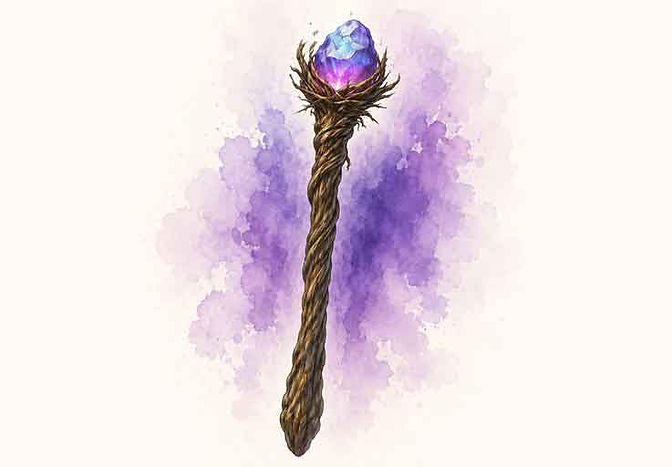
The physical characteristics of Merlin's staff as commonly conceived are drawn from the broader tradition of the wizard's implement in European folklore and modern fantasy. It is typically depicted as approximately the height of the wielder, made of ancient oak or yew wood - the traditional woods of druidic magic in Celtic tradition. The shaft is often shown as twisted and gnarled, suggesting great age, and may be engraved with runes, astrological symbols, or ogham script. The top of the staff may be capped with a crystal, carved into the shape of an animal head (serpent, dragon, or raven), or formed into a gnarled knot. These details, while not attested in medieval Arthurian literature, draw on established Celtic and Germanic magical traditions.
In the context of Merlin's legendary feats, a staff or similar implement would have been the tool through which he performed his greatest enchantments. When Merlin magically transported the massive stones of the Giant's Ring from Ireland to create Stonehenge, as recounted in Geoffrey of Monmouth, he would have used his staff as the channeling implement for this enormous working of magic. Similarly, the enchantment placed upon the Sword in the Stone - the magical condition that only the rightful king of Britain could draw it forth - would have been wrought through the staff. The protective enchantments woven over the infant Arthur when Merlin spirited him away to be fostered by Sir Ector would likewise have required such a focus.
Merlin's shapeshifting abilities - his power to transform into any animal or human form at will - may also have been facilitated by the staff in some traditions. In folklore, the wizard's implement often serves as the anchor of the magician's identity during transformation, and as the tool used to trigger the change. The staff also traditionally serves as an aid to prophecy and scrying, enhancing the seer's ability to perceive events across time and space - a power Merlin possessed in abundance.
The modern concept of Merlin's staff as a specific named artifact with defined powers is largely a creation of 20th- and 21st-century fantasy literature and gaming. In these contexts, the staff is typically attributed with powers of spell amplification, elemental channeling, barrier creation, and flight or levitation. While these specific powers are not drawn from medieval sources, they are consistent with the abilities attributed to Merlin in the original texts: control over elements, enchantment, prophecy, and shapeshifting. The staff serves as the physical focus through which these innate abilities are directed and amplified.
The staff as a symbol carries deep resonances. It represents Merlin's role as the wise elder and guide, the teacher and mentor to Arthur. As a vertical object connecting earth and sky, it embodies the wizard's function as intermediary between the mortal realm and the supernatural world. And as a walking staff that supports the traveller on a long journey, it represents Merlin's burden of knowledge - a being who carries the weight of all times upon his shoulders.
Summary
Merlin's staff, while not described in canonical detail in the primary medieval Arthurian texts, has become an integral part of the wizard's image through centuries of artistic tradition and modern fantasy interpretation. It represents the channeling of magical power, the authority of wisdom, and the burden of supernatural knowledge. From medieval manuscript illuminations to modern gaming, the staff has become inseparable from the figure of Merlin, the archetypal wizard whose influence on the fantasy genre is incalculable.
References
Validation References: 1. Geoffrey of Monmouth, Historia Regum Britanniae, c. 1136 - Merlin's magic (staff not specified) 2. Vulgate Cycle, c. 1215-1235 - Merlin's magical deeds 3. Thomas Malory, Le Morte d'Arthur, 1485 - synthesis of Merlin traditions 4. Medieval manuscript illuminations, British Library collections, 13th-15th centuries 5. Matthews, John, The Wizard's Staff: A History of Magical Implements (various) 6. Green, Miranda, The Gods of the Celts (Alan Sutton, 1986) - druidic staff traditions 7. Kieckhefer, Richard, Magic in the Middle Ages (Cambridge University Press, 1989) 8. Spence, Lewis, The Magic Arts in Celtic Britain (Aquarian Press, 1989)