Greek Mythology List


Welcome to the Mythopouch list of Greek mythology entries! We also delve into the ancient history of Greece and the surrounding areas. From heroes to goddesses, places. monsters, artifacts, weapons, creatures and more - which will only grow over time. Mythopouch provides real-world information extracted from the original source material such as that from: Homer, Hesiod, Apollodorus, Ovid, Pausanias, Pindar, Aeschylus, Sophocles, Euripides, Hyginus, Diodorus Siculus and Apollonius of Rhodes. Words and stories carry powerful messages that were passed down from one generation to the next, many of which are still very applicable to modern times. Our unique imagery is meant to capture the imagination and ignite the magic mythology spark within us all. Our "token mark" coin symbol that is assigned to each record is a visual representation of the entity, for use in Mythopouch learning modules and games.
Earn - Learn - Play
See more entries

Metis
Metis is the Titan goddess of wisdom, cunning, and deep counsel, the first wife of Zeus who helped him win the throne of Olympus and was then devoured by him in fear of her own power. She is the shapeshifter who transformed into a fly to escape her husband and was swallowed whole, trapped forever within the king of gods. She is the mother of Athena, the goddess of wisdom and warfare, whom she crafted armour for while imprisoned inside Zeus's skull, hammering out a helmet and weaving a robe until the pounding drove her captor to madness. She is the architect of the Titanomachy, the war between the old Titans and the young Olympian gods, who devised the emetic potion that forced Cronus to vomit up the children he had swallowed. She is the personification of metis itself, the Greek quality that combines wisdom with cunning, the same trait that made Odysseus, the cunning king of Ithaca, the most resourceful of all Greek heroes. She is the only deity in Greek mythology who was defeated not by force but by being outsmarted at her own game, and whose voice still whispers counsel from within the god who consumed her. Every clever plan, every shapeshifting trick, and every burst of wisdom from an aching head carries her ancient signature.
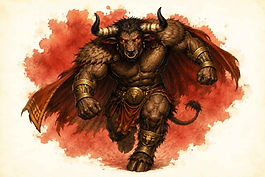
Minotaur
The Minotaur is the half-man, half-bull monster who lived at the center of the Labyrinth, the vast maze beneath the palace of Knossos on the island of Crete, a creature born from a queen's forbidden desire and a god's cruel jest. He is the devourer of Athenian youths, the beast who fed on the tribute of seven young men and seven maidens sent every nine years from Athens to satisfy his hunger for human flesh. He is the offspring of Pasiphae, the wife of King Minos of Crete, and a white bull sent by the sea-god Poseidon, a union made possible only because the master craftsman Daedalus built a hollow wooden cow to hide the queen's shame. He is the enemy that the hero Theseus traveled to Crete to destroy, armed with nothing but a sword and a ball of thread given to him by the princess Ariadne, Minos's own daughter, who betrayed her family for love. And he is the namesake of the labyrinth itself, a word that still means any maze so complex that finding the centre means risking never finding the way out again.
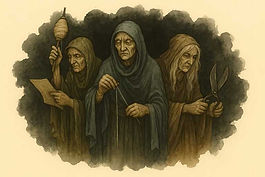
Moirai
The Moirai are the three sisters who spin, measure, and cut the thread of every life that enters the world, deciding how long each mortal and even each god shall endure.
Clotho - The Spinner
Lachesis - The Allotter
Atropos - The Inevitable
Clotho spins the thread of life upon her spindle at the moment of birth, drawing raw existence from the void. Lachesis measures its length with her rod, allotting years and fortunes to kings, beggars, and heroes alike. Atropos, the eldest and most terrible, waits at the end with her bronze shears, and when the measured thread runs out she cuts it without mercy, and no power in heaven or earth can stay her hand. Even Zeus, king of the Olympian gods, is said to bow before their decrees, for the Fates stand outside the order of the gods themselves, older than Olympus and more absolute than law. They appear at every birth, at every turning point, and at every deathbed, and their presence is felt in every prophecy that cannot be escaped, every curse that must be fulfilled, and every life that ends exactly when it was always going to end.

Mount Olympus
Mount Olympus is the sacred mountain where the twelve great Olympian gods made their eternal home, a place so high that its peaks pierced the clouds and its summit lay beyond the reach of mortal men. It is the throne room of Zeus, the king of the gods, from whose seat he hurled thunderbolts and governed the affairs of heaven and earth. It is the site of the divine council, where the gods gathered to debate the fates of heroes and nations, their voices echoing through halls of gold and marble. It is the fortress that withstood the assault of the monstrous Typhon, a creature of a hundred serpent heads who tried to storm the heavens and overthrow the gods. It is the place where Hera, queen of the gods, plotted and schemed from her own golden chambers, and where Athena, the goddess of wisdom, was born fully armed from the head of her father. And it is the mountain that still stands today in northern Greece, its summit wreathed in clouds, a landmark that has inspired pilgrims, poets, and adventurers for nearly three thousand years.

Muses
The Muses are the nine divine sisters who breathe inspiration into every poet, musician, historian, and astronomer who ever sought to capture truth in words or song. They are the daughters of Zeus, the king of the gods, and Mnemosyne, the Titaness of memory, born from nine nights of union so that mortals might never forget what the gods have revealed. Each sister governs a single art: Calliope commands epic poetry, Clio chronicles history, Euterpe fills the air with flute music, Thalia inspires comedy, Melpomene wears the mask of tragedy, Terpsichore leads the dance, Erato whispers love poetry, Polyhymnia raises sacred hymns, and Urania maps the wandering stars. They appear to the desperate and gifted alike, and once they seize a mortal mind they do not let go until the work is finished. Homer, the blind poet who composed the Iliad and the Odyssey, begged them to sing through him. Hesiod, the shepherd who became the father of Greek cosmology, met them on Mount Helicon and received the order of the universe in a single vision. Every library still bears their signature, for the Muses are the reason human beings do not merely live but remember, celebrate, and understand.
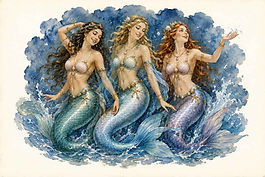
Nereids
The Nereids are the fifty daughters of Nereus, the Old Man of the Sea, and they are the most beloved sea-nymphs in all of Greek mythology, graceful spirits who danced upon the waves and guided sailors through storm and calm. They are the attendants of the sea-god Poseidon, who ruled the oceans from his underwater palace of coral and pearl, and they are the companions of the hero Achilles, the greatest warrior of the Trojan War, who was born of a Nereid mother and mourned by his sea-nymph kin when he fell. They are the rescuers of the Argonauts, the crew of heroes who sailed in search of the Golden Fleece, when their ship was trapped between the crushing rocks of the Symplegades. They are the weepers at the funeral of Patroclus, Achilles' dearest friend, whose death drove the hero to a rage that nearly turned the tide of the Trojan War. And they are the eternal spirits of the Mediterranean itself, the silver shapes that ancient sailors glimpsed in the foam and mist, a reminder that the sea was never empty but always alive with divine presence.

Nymph
The Nymph is the spirit of the wild place made flesh, a maiden of eternal youth who dwells in the springs, trees, caves, and mountains of the Greek world, as much a part of the landscape as the water she guards or the grove where she dances. She is the companion of the gods, the attendant of Artemis, the goddess of the hunt, who roamed the wilderness with a band of nymphs at her side, and the lover of Hermes, the messenger god, whose swift feet carried him to secret glades where nymphs bathed in silver pools. She is the mother of heroes, the bride of mortal men who stumbled upon her beauty and were never the same again, and the weeping figure who fades into her tree or spring when love is lost or youth departs. She is the voice that echoes in caves, the shimmer on a forest pool, the rustle in leaves that has no wind to cause it, and the reason the ancient Greeks believed that no wild place was ever truly empty but always alive with presence, watching, waiting, and dancing just beyond the edge of sight.

Oceanids
The Oceanids are the three thousand daughters of Oceanus, the Titan god of the world-encircling river, and Tethys, his sister and wife, the Titaness of the fertile waters. They are the nymphs of every spring, fountain, well, and freshwater stream that flows from the earth, and the guardians of the liquid boundary that separates the known world from the lands of the dead. Every mortal who draws water from a sacred spring speaks to the Oceanids whether they know the names or not. The eldest among them, Styx, the nymph of the river that borders the underworld, is so sacred that the gods themselves swear their most binding oaths upon her waters, and any god who breaks such an oath is cast into a coma for nine years. Other famous daughters include Metis, the first wife of Zeus who was swallowed whole while pregnant with Athena, and Doris, the mother of the fifty sea-nymphs called the Nereids. The Oceanids are not merely decorative spirits of nature; they are the mothers of gods, the witnesses of divine treaties, and the living network of freshwater that makes civilization possible.

Odysseus
Odysseus is the hero who spent ten years fighting at Troy and another ten years trying to get home, the most cunning man in all of Greek mythology and the only warrior whose wits were sharper than his sword. He is the architect of the Trojan Horse, the giant hollow wooden horse that the Greeks hid inside to infiltrate and destroy the city of Troy, ending a war that had lasted ten years. He is the wanderer who faced the Cyclops Polyphemus, a one-eyed giant who devoured his men, and escaped by tricking the monster into drunkenness and blinding him with a sharpened stake. He is the castaway who survived the wrath of Poseidon, the god of the sea, who pursued him across the Mediterranean with storms and shipwrecks for the crime of blinding his son Polyphemus. He is the husband who resisted the nymph Calypso, who offered him immortality and eternal youth on her island for seven years, because his heart belonged to Penelope, his wife waiting in Ithaca. And he is the king who returned in disguise, strung the bow that no other man could bend, and slaughtered the suitors who had invaded his house, reclaiming his throne through blood and cunning.

Orpheus
Orpheus is the musician whose song was so beautiful that trees bent to listen, rivers changed their courses, and the very stones wept, the greatest bard in all of Greek mythology and the only mortal whose art was stronger than death itself. He is the Thracian poet who descended into the underworld, the realm of Hades, the god of the dead who ruled from the darkness beneath the earth, to reclaim his beloved wife Eurydice from the grip of death, armed with nothing but his lyre and his voice. He is the husband who won her freedom with music that moved the Furies, the dread goddesses of vengeance who tormented the wicked with whips and serpents, to tears, only to lose her forever when he turned to look back before they reached the light. He is the founder of a mystery religion, the Orphic cult, whose followers believed that the soul was divine and imprisoned in the body, and that purification through ritual and abstinence could free it from the cycle of rebirth. He is the poet whose hymns and theogonies were attributed to him for centuries, shaping Greek religious thought as deeply as Homer shaped its epic imagination. And he is the torn body whose head, thrown into the river Hebrus by the Maenads, the frenzied female followers of Dionysus, the god of wine and ecstatic revelry, still sang as it drifted to the sea.

Pan
Pan is the goat-foot god of the wild who haunts the mountains of Arcadia, his horned head crowned with pine and his laughter echoing through the valleys. He is the inventor of the panpipes, the haunting instrument he carved from the reeds of a nymph who escaped his embrace by transforming into marsh plants. He is the god whose sudden, terrible cry sends armies into blind flight, a phenomenon called panic after his name. He is the shepherd who watches over flocks and hunters alike, protector of the lonely places where civilization ends and the wilderness begins. He is the companion of Dionysus, the god of wine and ecstatic revelry, riding with satyrs and maenads through the forests in midnight celebration. And he is the god whose supposed death was reported across the Mediterranean during the reign of the Roman emperor Tiberius, a moment that marked the passing of an age.

Pandora's Jar
Pandora's Jar is the sealed clay vessel that unleashed every evil upon the human race, the most destructive gift ever given by the gods and the single object that transformed mortal life from ease and plenty into struggle, suffering, and toil. It is the container that held every sorrow the gods could devise, from disease and famine to war and despair, all packed into one jar and given to the first woman, Pandora, as her dowry when she was sent down to earth to punish mankind for the theft of fire by Prometheus, the Titan who stole divine flame for humanity and was chained to a rock for eternity as punishment. It is the vessel that Pandora opened in curiosity, releasing plagues and pains into the world like a swarm of black insects, and that she slammed shut just in time to trap one thing at the bottom, the one thing that keeps humanity from total despair. It is the jar that became a box in later centuries when a mistranslation by Erasmus, the Renaissance scholar, changed the Greek word pithos, meaning a large storage jar, into the Latin pyxis, meaning a small box, and so created one of the most famous misnomers in Western culture. And it is the symbol that still appears in every warning about unintended consequences, every cautionary tale about curiosity, and every debate about whether hope is a blessing or the cruellest torment of all.