Greek Mythology List


Welcome to the Mythopouch list of Greek mythology entries! We also delve into the ancient history of Greece and the surrounding areas. From heroes to goddesses, places. monsters, artifacts, weapons, creatures and more - which will only grow over time. Mythopouch provides real-world information extracted from the original source material such as that from: Homer, Hesiod, Apollodorus, Ovid, Pausanias, Pindar, Aeschylus, Sophocles, Euripides, Hyginus, Diodorus Siculus and Apollonius of Rhodes. Words and stories carry powerful messages that were passed down from one generation to the next, many of which are still very applicable to modern times. Our unique imagery is meant to capture the imagination and ignite the magic mythology spark within us all. Our "token mark" coin symbol that is assigned to each record is a visual representation of the entity, for use in Mythopouch learning modules and games.
Earn - Learn - Play
See more entries

Hephaestus
Hephaestus is the Olympian god of fire, metalworking, stonemasonry, sculpture, and craftsmanship. The son of Zeus and Hera (or in some traditions, born parthenogenetically from Hera alone as revenge for Athena's birth from Zeus), he is the only physically imperfect Olympian-lame from birth or from being thrown from Olympus by Zeus during a family quarrel. His fall to earth lasted a full day before he landed on the island of Lemnos.

Hera
Hera is the queen of the gods, goddess of marriage, women, childbirth, and family. Daughter of Cronus and Rhea, she is both the wife and sister of Zeus, making her the most powerful female deity in the Greek pantheon. Her cult was particularly strong in the Argolid region, where she was worshipped as the patron goddess of Argos.

Heracles
Heracles - Greek name Herakles, meaning "Glory of Hera" - was the greatest hero of Greek mythology. His name carries an irony central to his story: Hera, queen of the gods, persecuted him from birth to death, making his very identity a paradox. Born a mortal, suffering unimaginable trials, and eventually granted full divinity after death, Heracles stands alone as the only Greek hero to achieve apotheosis and take his place among the Olympian gods. He is the most frequently depicted hero in Greek art, appearing on thousands of vases, sculptures, reliefs, and coins from the 7th century BCE onward.
The earliest literary mentions appear in Homer's Iliad and Odyssey (c. 8th century BCE). Hesiod's Theogony (c. 700 BCE) records his birth and his role in sacking Troy. The fullest ancient account comes from Apollodorus's Bibliotheca (Books 2.4.8-2.7.8), while Diodorus Siculus provides a rationalized chronological narrative. Theocritus's Idylls offer important Hellenistic poetic treatments. Heracles was born at Thebes and his core narrative is purely Greek - though the Romans later adopted him as Hercules and added native Italian stories, the original hero remains fundamentally Greek in origin, deeds, and significance.

Hermes
Hermes is the Olympian god of messengers, travellers, merchants, thieves, herdsmen, orators, and the psychopomp who guides souls to the underworld. Son of Zeus and Maia (one of the Pleiades), he was born in a cave on Mount Cyllene in Arcadia and displayed his characteristic cunning from his first day of life, when he invented the lyre from a tortoise shell and stole Apollo's cattle.
Hestia
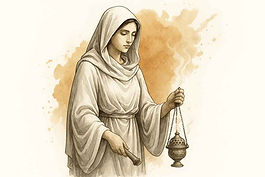
Hestia is the virgin goddess of the hearth, home, domestic fire, and family. The firstborn child of Cronus and Rhea, she was the first swallowed by her father and the last disgorged when Zeus forced him to release his children-making her simultaneously the eldest and youngest of the Olympian siblings. She chose perpetual virginity and a life of quiet service, tending the sacred hearth fire on Olympus.

Hippocampus
The Hippocampus was one of the most visually distinctive creatures in Greek mythology-a sea-being with the foreparts of a horse and the tail of a fish, embodying the ancient Greeks' perception of the sea as a realm where terrestrial and aquatic forms merged in wondrous and unexpected ways. The name itself is a transparent compound of the Greek hippos (ἵππος, "horse") and kampos (κάμπος, "sea monster" or "curved creature"), literally "horse-sea-monster." These creatures served primarily as the drawn steeds of Poseidon, god of the sea, pulling his chariot through the waves in one of the most iconic images of divine transportation in classical art. The modern seahorse (genus Hippocampus) takes its scientific name directly from this mythological creature, testament to the enduring resonance of the image.
The Hippocampus first appears in literary form in Homer's Iliad (8th century BCE), where Homer describes Poseidon driving over the sea's surface in a chariot drawn by horses with bronze hooves-ambiguously equine creatures capable of moving across water. Later authors, particularly Apollonius of Rhodes in his Argonautica (3rd century BCE), developed the Hippocampus into its fully hybrid form, describing Poseidon's horses as possessing golden manes and fish-like tails capable of propelling them through the water. In Hellenistic and Roman visual art, the Hippocampus became a standard element of Poseidon's iconographic retinue, appearing on coins, in mosaics, on pottery, and in sculpture throughout the Mediterranean world.

Hydra
The Hydra was a monstrous multi-headed water serpent of Greek mythology, born from the union of Typhon and Echidna - the same terrible parents who produced the Chimera, Cerberus, and other legendary monsters. Known specifically as the Lernaean Hydra from its haunt in the swampy marshes of Lerna near Argos, this creature was raised by the goddess Hera specifically to be a mortal enemy of Heracles. Its lair near the spring of Amymone was no accident: Lerna was a known entrance to the Underworld and a site sacred to Demeter, giving the Hydra a chthonic significance that elevated it beyond a mere monster to a guardian of the boundary between worlds.
The Hydra's most terrifying characteristic was its ability to regenerate. While the exact number of its heads varies by source - ranging from three to over fifty - most ancient writers attributed between six and nine heads to the beast. For each head cut off, two more would grow in its place, making the creature seemingly impossible to kill. One of its heads was immortal, undying by any natural means. Its breath was toxic, its venom lethal, and even contact with its blood or tracks could prove fatal. The Hydra thus represented not merely physical danger but the terrifying multiplication of problems - a symbol of challenges that grow worse the more one tries to solve them.

Khalkotauroi
The Khalkotauroi - whose name derives from the Greek words khalkos (χαλκός, "bronze/copper") and tauros (ταῦρος, "bull") - were a pair of monstrous, fire-breathing bronze bulls in Greek mythology. Forged by Hephaestus, the Olympian god of metalworking and divine craftsmanship, these automatons stood among the most formidable guardians in the Greek mythic tradition. They were living machines of bronze, endowed with preternatural strength and the ability to exhale scorching flames from their metallic mouths, making them nearly invulnerable to conventional weapons and impossible for any mortal to approach, let alone subdue.
Unlike natural beasts, the Khalkotauroi were divine artifacts - automatons animated by Hephaestus's unparalleled skill at the forge. Their hooves were cast from solid bronze, earning them the epithet Khalkopodoi ("Bronze-Footed"), and their jaws were likewise forged from bronze, giving them the name Pyripnooi ("Fire-Breathing"). These were not mere animals but sophisticated constructs of divine engineering, representing one of the earliest conceptions of artificial life in Western literature. Their bronze construction rendered them immune to normal weapons, and their fire breath - hot as a smith's furnace - could incinerate anything in their path.
The Khalkotauroi are best known from Apollonius Rhodius's Hellenistic epic, the Argonautica (3rd century BCE), where they serve as central obstacles in Jason's quest for the Golden Fleece. They also appear in Pseudo-Apollodorus's Bibliotheca, Seneca's tragedies, Valerius Flaccus's Roman Argonautica, and other classical sources, cementing their place as iconic figures in the canon of Greek monstrous guardians.

Medea
Medea is one of Greek mythology's most complex and formidable female figures-a princess, priestess of Hecate, sorceress, and tragic heroine. The daughter of King Aeëtes of Colchis (son of Helios) and the Oceanid Idyia, she possessed profound knowledge of magic, herbs, and poisons that she learned from her aunt Circe and her grandmother Hecate.

Medusa
Medusa was one of the three Gorgon sisters in Greek mythology, the only mortal among them, and the most feared monster of the archaic Greek world. Her name, derived from the Greek verb medein ("to guard, protect"), may originally have meant "Guardian" or "Sovereign Female Wisdom." Born of the primordial sea deities Phorcys and Ceto, Medusa possessed a gaze that turned anyone who looked directly at her to stone, and serpents for hair that writhed and struck with venomous bites. Her severed head, the Gorgoneion, became one of the most powerful protective symbols in the ancient world.
The earliest literary mention of the Gorgons appears in Homer's Iliad (c. 8th century BCE), where the Gorgon head appears as an apotropaic decoration on Athena's shield and on Agamemnon's. The first complete genealogy comes from Hesiod's Theogony (c. 700 BCE), lines 270-285, which describes her parentage, her mating with Poseidon, and the birth of Pegasus and Chrysaor from her severed neck. The famous backstory of her transformation from a beautiful priestess into a monster comes from Ovid's Metamorphoses (8 CE), Book 4 - a Roman source not part of the original Greek tradition.

Meliae
The Meliae were ash tree nymphs of Greek mythology, born from the blood of Uranus (the Sky) when he was castrated by his son Cronus. According to Hesiod's Theogony, as the blood from that terrible wound fell upon Gaia (the Earth), she conceived and bore three distinct beings: the Erinyes (Furies), goddesses of vengeance; the Gigantes (Giants), in gleaming armor; and the Meliae - gentle nymphs associated with the ash tree (melia in Greek). This violent origin paradoxically produced beings of nurturing and protective character, embodying the Greek understanding that creation often emerges from destruction.
The Meliae were specifically connected to the ash tree, which held special significance for ancient Greeks. The wood of the ash was strong yet flexible, making it the preferred material for spear shafts - the very weapons that men used in war. This connection between the Meliae and the implements of combat created a symbolic link between nature and human civilization: these nymphs represented the earth providing for humanity's needs, even for the tools of conflict. The ash tree was thus not merely a plant but a source of martial power, guarded by divine spirits.

Menelaus
Menelaus was the king of Sparta and the husband of Helen, whose abduction by the Trojan prince Paris sparked the Trojan War. As the younger son of Atreus and Aerope, and brother of Agamemnon, he was a prominent Greek leader, though overshadowed by his elder brother's authority and by the greater heroes like Achilles and Odysseus.