Greek Mythology List


Welcome to the Mythopouch list of Greek mythology entries! We also delve into the ancient history of Greece and the surrounding areas. From heroes to goddesses, places. monsters, artifacts, weapons, creatures and more - which will only grow over time. Mythopouch provides real-world information extracted from the original source material such as that from: Homer, Hesiod, Apollodorus, Ovid, Pausanias, Pindar, Aeschylus, Sophocles, Euripides, Hyginus, Diodorus Siculus and Apollonius of Rhodes. Words and stories carry powerful messages that were passed down from one generation to the next, many of which are still very applicable to modern times. Our unique imagery is meant to capture the imagination and ignite the magic mythology spark within us all. Our "token mark" coin symbol that is assigned to each record is a visual representation of the entity, for use in Mythopouch learning modules and games.
Earn - Learn - Play
See more entries

Dionysus
Dionysus is the Olympian god of wine, viticulture, fertility, theatre, ecstasy, and religious madness. He is unique among the Olympians as the son of Zeus and a mortal woman, Semele, princess of Thebes. When Semele was consumed by Zeus's divine glory after Hera tricked her into demanding to see his true form, Zeus rescued the unborn Dionysus by sewing him into his thigh, from which the god was "born again"-earning him the epithet "twice-born."

Dracaenae
The Dracaenae were a category of female monsters in Greek mythology distinguished by their hybrid form: the upper body of a beautiful woman and the lower body of a serpent or dragon. The term drakaina (δράκαινα) is the feminine form of drakōn (δράκων, "dragon" or "serpent"), making these creatures literally "she-dragons." Unlike the more famous individual monsters of Greek myth, the Dracaenae functioned primarily as a type-recurring figures encountered at the boundaries of the civilized world, particularly in the wild territories of Scythia and in the depths of Tartarus. They embodied the Greek fascination with hybrid creatures that combined human intelligence and beauty with animalistic, chthonic power, and their serpentine lower bodies connected them to earth, fertility, and the primordial forces that preceded the Olympian order.
The most famous of the Dracaenae was the Scythian Dracaena (Drakaina Skythia), whose encounter with Heracles during his labors gave rise to the foundational myth of the Scythian people. Recorded by Herodotus in his Histories (Book 4, chapters 8-10) in the 5th century BCE, this narrative represents one of the earliest and most detailed accounts of cultural interaction between Greeks and non-Greek peoples refracted through mythological storytelling. The Scythian Dracaena was a creature of the northern Black Sea region, dwelling in the wooded wilderness of Hylaea, where she possessed a woman's form above the waist and serpentine coils below. Her story is inseparable from Greek ethnographic speculation about the origins of foreign peoples.

Dryad
The Dryads were the tree nymphs of Greek mythology, spirits whose lives were intimately bound to the forests and woodlands they inhabited. The term derives from the Greek drys (δρῦς), meaning "oak," indicating that the original Dryads were specifically the nymphs of oak trees, though the term broadened over time to encompass nymphs associated with trees of all kinds. These were not merely nature spirits in the abstract but embodied guardians of particular trees and groves, representing a profoundly animistic conception of the natural world in which every significant tree housed a conscious, sentient presence capable of pleasure, pain, and retribution.
The Dryads belonged to the broader class of nymphs-female nature divinities who populated Greek landscapes from mountain peaks to freshwater springs. But the Dryads carried a unique vulnerability: their existence was bound to their trees. For the general Dryad, harm to her forest brought suffering; for the Hamadryad (Ἁμαδρυάς, "together with the tree"), the bond was absolute-if her specific tree died, she died with it. This fundamental fragility distinguished Dryads from the immortal Olympian gods and even from other nymphs. It made them passionate defenders of their arboreal homes and invested acts of tree-cutting with religious and moral significance that extended far beyond practical resource management.

Eros
Eros, the god of love and desire, occupies a uniquely dual position in Greek mythology - a deity who exists simultaneously as one of the most ancient forces in the cosmos and as the playful, mischievous son of Aphrodite. These two distinct traditions reflect the Greeks' profound understanding that love operates on multiple levels: as a cosmic principle that binds the universe together, and as the personal, often unpredictable force that stirs individual hearts.
In the first and older tradition, as recorded in Hesiod's Theogony, Eros is a primordial deity, one of the first beings to emerge directly from Chaos itself. This ancient Eros is no child with a bow - he is a fundamental force of creation, the spirit of Love whose beneficent power "reduced to order and harmony the shapeless, conflicting elements" of the newborn universe. Without this primordial Eros, the disparate elements of creation would never have united to form the ordered cosmos.
Gaia
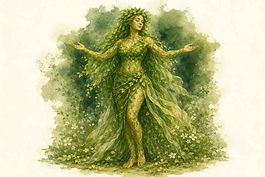
Gaia is the primordial goddess and personification of the Earth, the first being to emerge from Chaos according to Hesiod's Theogony. She is the ever-firm foundation of all, the nourishing mother from whom all life springs. As the Earth itself, Gaia is both a divine being and the physical ground beneath all existence.
Graeae
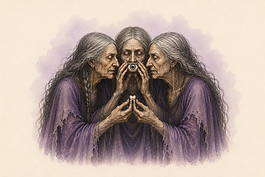
The Graeae - whose name means "the Grey Ones" or "Old Women" - were three sisters of Greek mythology who served as guardians of the Gorgons and possessors of secret knowledge. Born to the primordial sea deities Phorcys and Ceto, they were sisters to the three Gorgons (including Medusa), Scylla, Thoosa, and other monstrous beings of the deep. Their names were Deino (Dread), Enyo (Horror), and Pemphredo (Alarm) - names that evoked the fear their appearance inspired. From birth, they were old: gray-haired, wrinkled, and haggish, personifying old age itself rather than merely experiencing it.
The Graeae's most distinctive and famous attribute was their shared physical limitation: among the three of them, they possessed only one eye and one tooth, which they passed back and forth as needed. This grotesque arrangement made them simultaneously powerful and vulnerable - the eye gave them extraordinary knowledge and wisdom, but its shared nature made them dependent on each other and, crucially, susceptible to anyone who could seize it. Their role as guardians of the Gorgons placed them at a strategic crossroads in Greek mythology: to reach Medusa, any hero would have to pass through the Graeae's domain and somehow extract from them the location of the Gorgon's lair.

Hades
Hades is the god of the underworld and the dead, one of the three sons of Cronus and Rhea who divided the cosmos after defeating the Titans. While his brothers Zeus and Poseidon received the sky and sea respectively, Hades drew the underworld as his domain. He is not a malevolent figure but a stern, just ruler who presides over the realm of the dead with unwavering authority.

Harpy
The Harpies were winged female spirits of Greek mythology whose name - harpýia, from the Greek verb meaning "to snatch" - perfectly described their nature as divine agents of theft and punishment. These terrifying creatures possessed the bodies of birds and the faces of women, embodying a grotesque fusion of human intelligence and animal savagery. They served as instruments of the gods' vengeance, particularly against those who had committed crimes against the divine order or who had somehow evaded proper punishment.
In Hesiod's Theogony, the Harpies are described as "lovely-haired" spirits who flew faster than the wind and the birds, swooping down upon their victims with terrifying speed. Over time, their depiction grew increasingly monstrous - later sources emphasized their repulsive qualities: filth oozing from their bodies, a rank stench that preceded their arrival, and the despoiling touch that rendered everything they contacted unclean. They were creatures not merely of punishment but of pollution, transforming bounty into waste and sustenance into rot.

Hecate
Hecate is the goddess of magic, witchcraft, crossroads, ghosts, necromancy, and the night. The daughter of the Titan Perses and the Titaness Asteria, she holds a unique position in the Greek pantheon-honored by Zeus with power in all three realms: the sky, the earth, and the underworld. She is particularly associated with liminal spaces and transitions, guarding the thresholds between worlds.

Hecatoncheires
The Hecatoncheires - the "Hundred-Handed Ones" - were three primordial giants of such terrifying appearance and overwhelming might that even the Titans feared them. Named Cottus (the Striker or Furious), Briareus (also called Aegaeon, the Vigorous or Sea-Goat), and Gyges (or Gyes, the Big-Limbed), each brother possessed fifty heads and one hundred arms. Born to Uranus (Sky) and Gaia (Earth) as part of the first generation of divine beings, they embodied the raw, untamable forces of nature - earthquake, tidal wave, and volcanic eruption made flesh.
Their father Uranus, horrified by their monstrous appearance, thrust them back into Gaia's womb, causing her immense pain. When Cronus overthrew Uranus, he too imprisoned the Hecatoncheires in Tartarus, where the dragon Campe guarded them. They remained in this dark prison until Zeus, guided by Gaia's counsel, freed them to serve as allies in the Titanomachy. Their liberation proved decisive: the three brothers could hurl three hundred mountain-sized rocks simultaneously, overwhelming the Titan forces and securing victory for the Olympians. After the war, they became the eternal guards at the bronze gates of Tartarus, ensuring that the imprisoned Titans could never escape.

Hector
Hector is the greatest Trojan warrior and the noblest hero of the Trojan War, the eldest son of King Priam and Queen Hecuba. As Troy's champion, he bore the weight of his city's defense against the Greek invaders for ten years, earning universal respect for his courage, honor, and devotion to family and homeland.

Helen of Troy
Helen of Troy was the most consequential female figure in Greek mythology - a woman whose abduction from Sparta precipitated the Trojan War, the defining conflict of the heroic age. Daughter of Zeus (by Leda or, in an older tradition, by Nemesis), Helen was consistently described as the most beautiful woman in the world, a beauty so extraordinary that it transcended ordinary standards. Christopher Marlowe's famous phrase "the face that launched a thousand ships" captures the ancient tradition: her departure from Sparta mobilized the combined forces of Greek kings and princes against Troy, setting in motion a ten-year war that would shape Greek cultural identity for millennia.
Helen is also one of the most ambiguous and debated figures in Greek mythology. The earliest literary portrait appears in Homer's Iliad and Odyssey (c. 8th century BCE), where she is portrayed as a complex, self-aware woman painfully conscious of her role in the destruction around her. Sappho (c. 600 BCE) described her as a woman who eloped of her own accord. Herodotus (c. 440 BCE) offered a rationalized version in which Helen never actually went to Troy. Euripides' Helen (412 BCE) presented the "phantom Helen" tradition in which only a likeness, not the real woman, was at Troy. Helen resists single interpretation more than any other Greek mythological figure.